Blog · Aquaculture PCR ·
Lyophilised qPCR vs wet-reagent PCR and LAMP for shrimp pathogen screening on the farm
Shrimp cannot be vaccinated and cannot be treated for the viruses that kill them, so the entire economics of a farm rests on keeping pathogens out and finding them early. Which test does that job depends less on the chemistry in the tube than on whether the tube can survive the journey to the pond. This post compares the molecular methods used for shrimp pathogens and explains what freeze-drying the reagent changes for a farm without a laboratory.
Why shrimp are screened, not treated
Crustaceans have an innate immune system only: no antibodies, no immune memory, no vaccine. A pond that survived white spot last year is not protected this year. Control therefore means exclusion of infected post-larvae, broodstock, live feed and carriers, and early detection during the crop so a positive result triggers a partial harvest or a management change before the pond collapses. Every one of those decisions is a molecular test, and most of them have to be made where there is no laboratory.
Four molecular methods compared
Conventional and nested PCR. The historical reference for WSSV, IHHNV and EHP. Two rounds of amplification and a gel give very high sensitivity, but the open-tube second round is the classic source of amplicon contamination, the run takes three to four hours, the result is a band read by eye, and it requires a proper laboratory with separated rooms.
Real-time (quantitative) PCR. Closed-tube fluorescence detection, a result in about an hour, and a cycle-threshold value that reflects pathogen load. Load matters in shrimp: a weak positive in a grow-out pond and a strong positive in a batch of post-larvae call for different actions. WOAH lists real-time PCR alongside nested PCR as a recommended method for the major shrimp viruses.
LAMP and other isothermal chemistries. Fast, simple heating, visual read-out. Attractive for field use, but primer design for six-primer LAMP is difficult, multiplexing is limited, and the very high amplicon yield makes carry-over contamination a persistent risk in a farm setting. It is best used as a single-target screen with strict physical separation of steps.
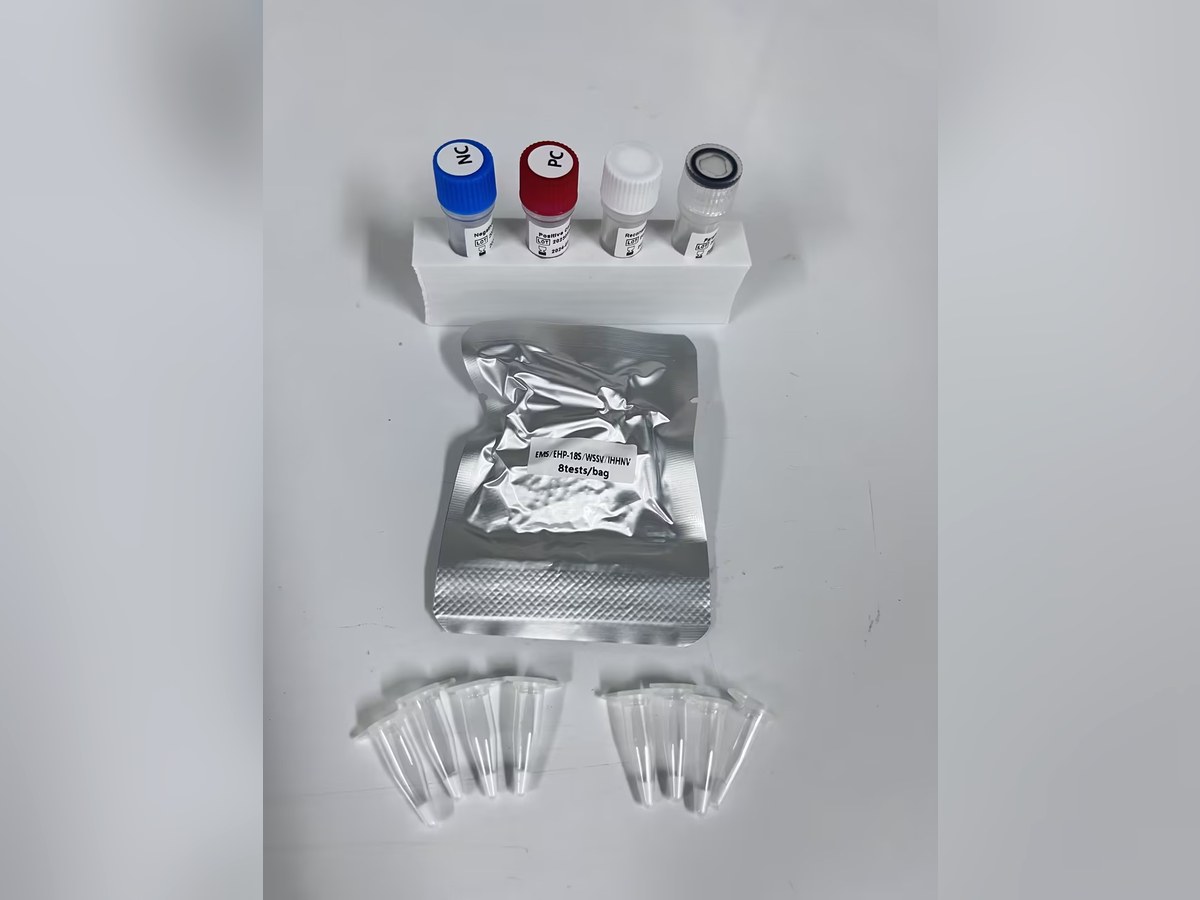
Lyophilised (freeze-dried) real-time PCR. The same chemistry as wet-reagent qPCR, with the master mix, primers and probe dried in the tube. The kit ships and stores at ambient temperature, the operator adds the extract and water, and the tube goes straight into the analyser. It removes the freezer, the pipetting of enzymes and most of the contamination opportunities in one step.
| Nested PCR | Wet-reagent qPCR | LAMP | Lyophilised qPCR | |
|---|---|---|---|---|
| Read-out | Gel band | Fluorescence, Ct value | Colour / turbidity | Fluorescence, Ct value |
| Time to result | 3–4 h | About 1 h | 30–60 min | About 50 min |
| Reagent storage | −20 °C | −20 °C, limited freeze–thaw | −20 °C or 4 °C | Ambient, months (see carton) |
| Contamination risk | High (open second round) | Low (closed tube) | High (amplicon yield) | Lowest (closed tube, minimal pipetting) |
| Quantitation | No | Yes | No | Yes |
| Multiplex | Difficult | Yes | Limited | Yes (duplex kits) |
| Operator | Trained technician | Trained technician | Basic training | Basic training |
| Where it runs | Laboratory | Laboratory | Field or laboratory | Farm, hatchery or laboratory |
What freeze-drying changes
Cold chain. A wet master mix must stay frozen from factory to bench and tolerates only a few freeze–thaw cycles. A farm three hours from the nearest freezer, or a hatchery whose power fails weekly, cannot hold it. A lyophilised tube is stable for months at ambient temperature, so the kit can sit on a shelf in the hatchery office.
Hands-on steps. With wet reagents the operator pipettes buffer, enzyme, primers, probe and template into each tube; each transfer is a contamination opportunity and a training requirement. With the dried tube there are two additions, extract and water. That is why a hatchery technician with a day's training runs it reliably.
Consistency. Every tube in a lot carries the same reagent mass; there is no pipetting variation between runs or operators, which is what makes Ct values comparable from week to week on the same pond.
Sensitivity. Properly formulated lyophilised chemistry matches its wet equivalent; the freeze-drying protects the enzyme rather than degrading it. Detection limits for the aquaculture line are stated per kit on the product pages.
A sampling plan that means something
A negative test on ten shrimp says little about a pond of a million. The WOAH sampling tables give the number of animals needed to detect a pathogen at a given prevalence with 95 percent confidence in a large population: 150 animals for 2 percent prevalence, 60 for 5 percent, 30 for 10 percent. Post-larvae are pooled, so a certification test on a batch is typically a pooled sample of 150 animals, sometimes split into several pools so a positive can be localised.
| Assumed prevalence | Animals to sample (large population, 95 % confidence) |
|---|---|
| 2 % | 150 |
| 5 % | 60 |
| 10 % | 30 |
| 20 % | 15 |
During the crop, a pooled sample of 10 to 20 shrimp from the feeding tray every two to three weeks, plus sediment from the feeding area between crops, is a practical minimum. Broodstock are tested non-lethally from faeces or pleopod biopsy; live feed such as polychaetes is tested by batch before it enters the hatchery.
The farm workflow, sample to decision
Collect: post-larvae, tissue, gill, hepatopancreas, faeces, feed or water, at the pond or hatchery. Prepare: extraction-free buffer for tissue in five minutes, or the magnetic-bead kit for water, sediment and batches. Run: rehydrate the lyophilised tube with the extract, load the compact 24-well analyser, result in about 50 minutes with the Ct on screen. Decide: reject or accept the batch, stop or continue live feed, harvest early or complete the cycle. The whole loop closes in an afternoon, on site, which is the difference between a screening programme that runs and one that exists on paper.
Cost, in the only units that matter
A test costs a few dollars of reagent and an hour of a technician's time. A lost crop costs the stocking, the feed, the power and the season. A hatchery that certifies every batch by qPCR sells post-larvae at a premium and keeps its customers; a farm that screens at stocking and every two weeks converts a WSSV outbreak from a total loss into a partial early harvest. The comparison between methods above is real, but the comparison between testing and not testing is the one that decides whether the farm is still there next year.
Written by the Medicare Vet product team from manufacturer data, WOAH guidance and published validation. Not a substitute for veterinary or laboratory advice in your market.
Products discussed
Catalogue items that apply to this note, each with its own page, specifications and quotation form. The full line is on the aquaculture pcr page.
- Nucleic Acid Detection Kit for White Spot Syndrome Virus (WSSV) (qPCR Method)AQ-11 · WSSV Nucleic Acid Detection Kit (qPCR Method)
- Nucleic Acid Detection Kit for Enterocytozoon hepatopenaei (EHP)(qPCR Method)AQ-01 · EHP
- Nucleic Acid Detection Kit for Acute Hepatopancreatic Necrosis Disease (AHPND)(qPCR Method)AQ-10 · AHPND Nucleic Acid Detection Kit (qPCR Method)
- Duplex Nucleic Acid Detection Kit for White Spot Syndrome Virus (WSSV) and Decapod iridescent virus 1 (DIV1) (qPCR Method)AQ-22 · WSSV & DIV1 Duplex Nucleic Acid Detection Kit (qPCR Method)
- Marine Animal Pathogen Nucleic Acid Extraction Kit (magnetic bead, single-test strip)AQ-76 · EXT-MB
- Aquatic Soil Environmental Pathogen Nucleic Acid Extraction Kit (magnetic bead, single-test strip)AQ-78 · EXT-SOIL-MB
- Compact real-time PCR analyser, 24-wellINS-MG242 · Micgene 242
Questions
How long does a lyophilised kit keep?
Months at ambient temperature; the exact shelf life and storage conditions are printed on the carton and the product page. Once rehydrated the tube is used the same day.
Can the same kit be run on a laboratory instrument?
Yes. The tubes fit standard real-time PCR instruments with the required fluorescence channels, as well as the compact 24-well analyser supplied for farm use.
Is LAMP a bad choice?
Not for a single target in a well-separated workflow. It is fast and simple. Its weaknesses are multiplexing, quantitation and contamination control, which are exactly the three things a screening programme needs most.
More from the blog
- Isothermal amplification vs lateral-flow vs laboratory PCR: choosing the right test for infectious disease in dogs and cats2026-09-22 · Isothermal amplification
- Quantitative immunofluorescence vs rapid tests for CRP and SAA: why a number changes case management2026-09-22 · Immunofluorescence
- Multiplex real-time PCR panels vs single-target tests: syndromic testing in the veterinary laboratory2026-09-22 · Real-time PCR
- EHP in shrimp: why the hepatopancreas looks normal until it is too late2026-09-21 · Aquaculture PCR
- White spot syndrome virus: three days from first sign to empty pond2026-09-21 · Aquaculture PCR
- Chairside molecular testing: what changes when PCR-grade results arrive in 30 minutes2026-09-21 · Isothermal amplification
- How to read a veterinary rapid test correctly, and when not to trust it2026-09-21 · Rapid test