Knowledge · Rapid test ·
How to read a veterinary rapid test correctly, and when not to trust it
A lateral-flow cassette is simple to run and easy to misread. Most disputed results trace back to five things: reading too early or too late, ignoring the control line, treating a faint line as negative, running a cold cassette, or testing a puppy in the fortnight after vaccination.
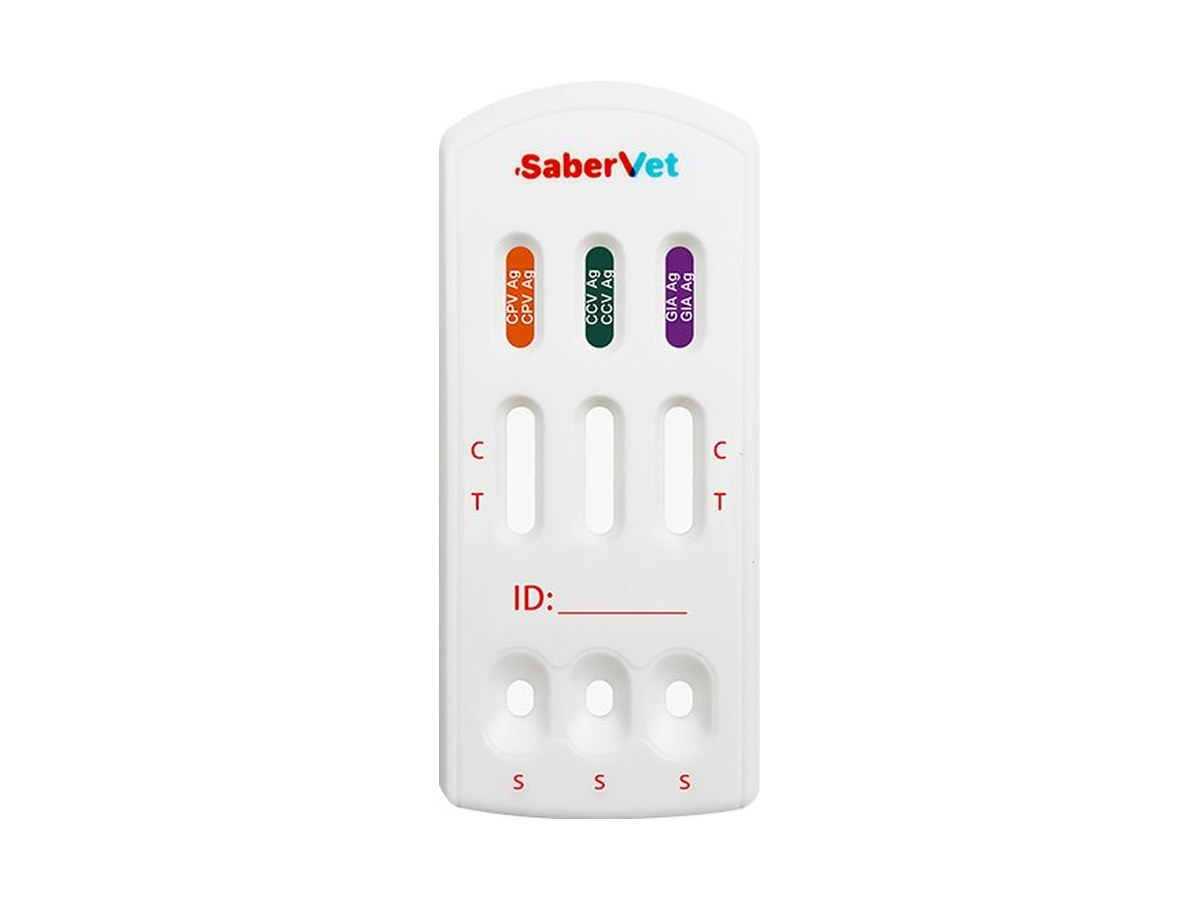
The control line comes first
Every cassette has a control line that confirms the sample flowed and the reagents worked. No control line means no result, whatever the test line shows: repeat with a new cassette and, if it fails again, check storage and the sample volume. A control line with no test line is negative; a control line with any test line is positive.
Read inside the window
Read at the time printed in the insert, usually 10 to 15 minutes after the sample is added. Before that, a weak positive may not have developed. After about 20 to 30 minutes, evaporation can produce a faint ghost line on a negative cassette. Set a timer, read once, and photograph the result for the record.
A faint line is a line
Antigen tests report a positive when the test line is visible at all; intensity depends on antigen load, sample volume and stage of infection, not on the certainty of the result. A faint line early in disease is common. If the clinical picture does not fit, repeat in 24 to 48 hours or confirm by PCR rather than calling it negative.
Temperature and storage
Cassettes are stored at 2 to 30 °C and must reach room temperature before opening; a cold cassette flows slowly and gives weak lines. Do not use a cassette whose pouch has been opened for more than an hour, or after the expiry date. Keep the buffer capped; evaporated buffer changes the flow.
Vaccine interference
Modified-live parvovirus vaccines can cause a weak positive on a faecal antigen test for four to ten days after vaccination, and live intranasal respiratory vaccines can do the same on swab tests. Record the vaccination date before testing and interpret weak positives in that window with care. Antibody tests are the opposite: they are expected to be positive after vaccination and are used to confirm immunity, not infection.
Antigen or antibody
Antigen tests detect the pathogen and answer 'is it infected now'. Antibody tests detect the immune response and answer 'has it been exposed or vaccinated'. Some diseases are diagnosed by one, some by the other, and a few (FIV, heartworm) by antibody or antigen depending on the design. The insert states which.
Written by the Medicare Vet product team from manufacturer data, WOAH guidance and published validation. Not a substitute for veterinary or laboratory advice in your market.
Products discussed
Catalogue items that apply to this note, each with its own page, specifications and quotation form. The full line is on the rapid test page.
Questions
Can a rapid test be used after the expiry date?
No. The antibodies on the strip degrade and the control line may still appear while the test line has lost sensitivity.
Can I use a swab instead of the supplied dropper?
Follow the insert. Most faecal and secretion tests are designed for a swab eluted in the supplied buffer; blood tests need the specified volume of whole blood, serum or plasma.
How should distributors train clinics?
A one-page card with the read window, the control-line rule, storage temperature and the vaccine window covers almost every support call. We supply one for each assay on request.
More from the knowledge pages
- EHP in shrimp: why the hepatopancreas looks normal until it is too late2026-09-21 · Aquaculture PCR
- White spot syndrome virus: three days from first sign to empty pond2026-09-21 · Aquaculture PCR
- Chairside molecular testing: what changes when PCR-grade results arrive in 30 minutes2026-09-21 · Isothermal amplification